
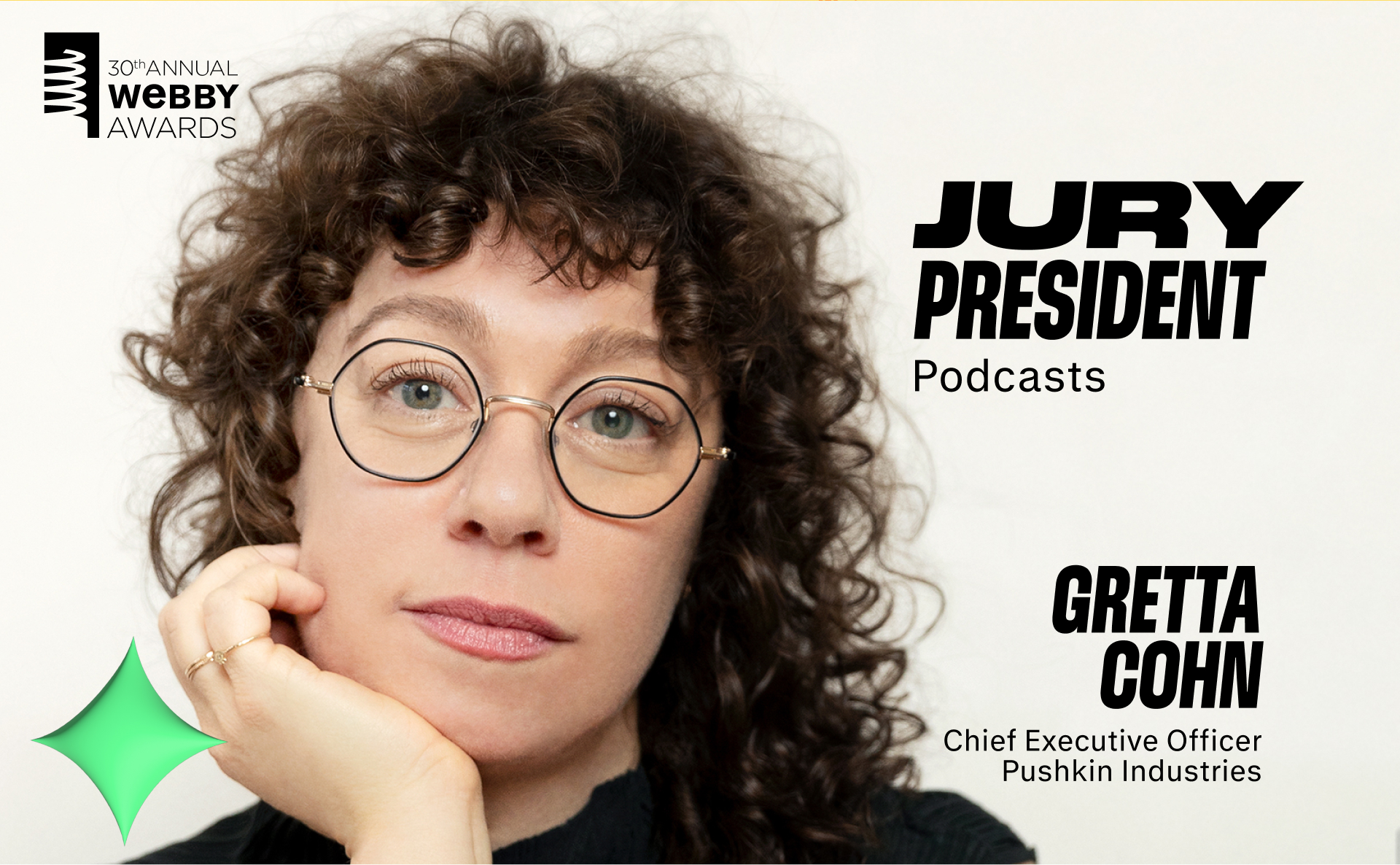


What do podcast listeners crave? In a flooded market, only shows with a clear point of view and real staying power cut through.
We spoke with Gretta Cohn, the Jury President for our Podcast category and CEO of Pushkin Industries, about what she’s listening for. Her company is celebrated for breakout projects like Malcolm Gladwell’s “Revisionist History” and “The Happiness Lab” with Dr. Laurie Santos.
According to Cohn, distinctness, depth and narrative cohesion emerged as her key signals of award-worthy work for the 30th Annual Webby Awards. Below, explore her tips for navigating today’s ever-evolving audio landscape.
“ Breakthrough work surprises me, not with gimmicks, but with clarity of purpose. I’m looking for stories that feel inevitable after you hear them, yet completely unexpected before.”
What changes/shifts are you seeing across your industry that excite you most?
I’m big on the return of intentionality in audio. After years of scale-at-all-costs, the industry is re-centering on craft: sharper editorial vision, more ambitious storytelling, and stories that take real time to earn trust. I’m also energized by the global expansion of narrative audio. We’re seeing formats evolve in ways that reflect local cultures and storytelling traditions, not just U.S. or U.K. models. And finally, I’m excited by the maturity of the audience: listeners are more discerning, more interactive, and more willing to follow creators into deeper, more layered storytelling experiences.
What’s your criteria for evaluating breakthrough work? What specific elements will make you think “this deserves a Webby Award?”
Breakthrough work surprises me, not with gimmicks, but with clarity of purpose. I’m looking for stories that feel inevitable after you hear them, yet completely unexpected before. A Webby Award-winning project shows mastery across every layer: reporting or research that’s airtight, structure that feels both bold and deliberate, and sound design that elevates rather than decorates. Most of all, I’m looking for emotional impact. A winning piece stays with you, something shifts, however subtly, in how you understand a person, a place, or a moment.
“ Authentic work has stakes for the people making it; trend-chasing rarely does. ”
How do you distinguish between authentic connection and trend-chasing?
Authenticity shows up in the specificity. When creators speak in a voice that’s clearly their own, not a feed-optimized version of themselves, you feel it immediately. Authentic work has stakes for the people making it; trend-chasing rarely does. I also look for audience response that reflects depth, not just virality: discussion, reflection, community formation.
What’s your criteria for identifying work that’s ahead of the curve?
Work that’s ahead of the curve tends to ask the question behind the question. It’s not responding to what listeners are doing today, but anticipating what they’ll crave tomorrow, ie, new narrative structures, new forms of participation, or new ways of blending genres. You can sense when a project is building a future pathway instead of following an existing one: the risks are intentional, the choices are principled, and the result feels like it expands the medium.
“ In award-level work, AI should make the craft more ambitious, not more generic.”
What’s your criteria for work that incorporates AI? What’s the line between AI-enhanced creativity and AI-generated content?
I want to see AI used as a tool, not a shortcut. AI-enhanced creativity supports the creator’s intent, helping with research organization, rough assembly, or accessibility without replacing the uniquely human voice at the center. The line is crossed when AI flattens authorship: when the emotional, ethical, or narrative core is driven by a model rather than by a person. In award-level work, AI should make the craft more ambitious, not more generic. If I can feel the human worldview and point of view guiding the final piece, then AI is serving creativity rather than diluting it.
What are the biggest challenges facing creatives in your industry today—and key strategies to navigating them?
One major challenge is the tension between sustainability and ambition. The economics of audio can push creators toward lower-risk, lower-lift formats, even as audiences still hunger for deeply reported, highly crafted storytelling. Another challenge is discoverability: even great work can disappear into an oversaturated ecosystem.
To navigate this, the most successful teams are doubling down on editorial distinctiveness and community-building. They’re choosing to make fewer projects, but projects with clearer missions and sharper identities. They’re collaborating across disciplines, leaning into partnerships that expand reach without compromising quality. And importantly, they’re building creative processes that protect time for deep work. Impact doesn’t come from sheer output; it comes from the courage to make something that could only have come from you.
Last Chance to Put Your Podcast on the Internet’s Biggest Stage
Think your project has what it takes to stand out? Submit your work to the 30th Annual Webby Awards to earn recognition for excellence. Enter by the Extended Deadline on Friday, February 6!
 Twitter